
A homeowner may first notice a trail of ants moving through the kitchen, across the patio, or along the exterior walls. However, ant problems around a Pasadena home can sometimes be only the most visible sign of a larger collection of pest-supporting conditions around the property.
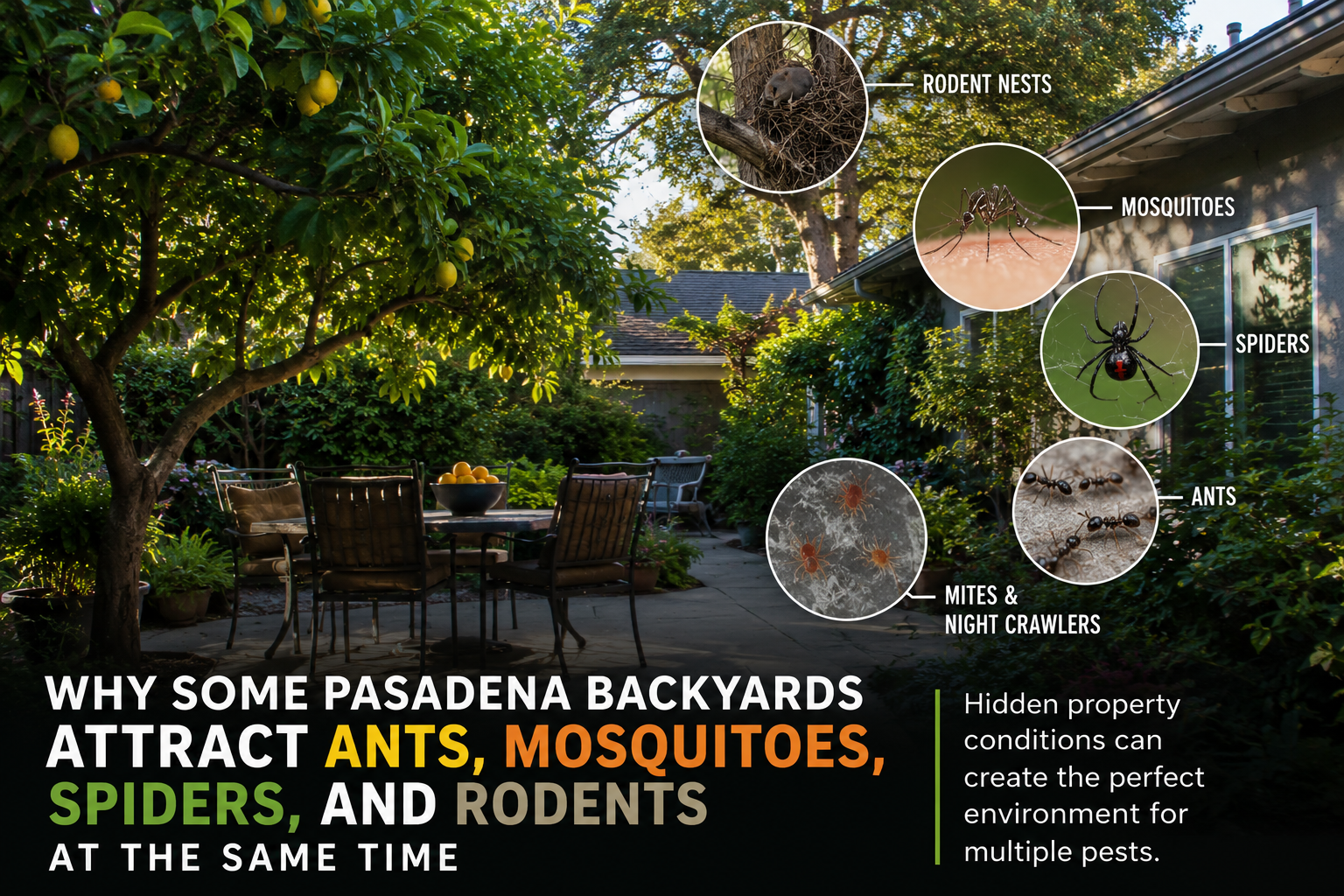
During one Pasadena-area service visit, the original complaint involved ants appearing throughout the property. A broader inspection revealed that the backyard environment was also supporting mosquitoes, spiders, nighttime crawling pests, and rodent nesting activity near an outdoor seating area.
The findings demonstrated why effective pest control often requires looking beyond the insect the homeowner initially sees.
Why Are Ants, Mosquitoes, Spiders, and Rodents Found Around the Same Backyard?
Different pests often use the same property for different reasons. Ants may be searching for moisture, plant-feeding insects, food residue, or access into the structure. Mosquitoes may rest inside shaded foliage during the day. Spiders position themselves where insect prey is plentiful. Rodents may select dense trees, rooflines, or protected elevated areas for nesting.
When these conditions exist close together, the backyard can become an interconnected pest environment rather than a series of unrelated infestations.
A fruit-bearing tree beside a patio may provide shade, moisture, dense leaves, and insect activity. Overgrown branches can also touch or extend toward gutters, eaves, fences, and roof edges. These connections create protected areas and possible travel routes for several kinds of pests.
Larry’s Inspection Notes
Larry G, Manager of All Track Exterminators, explained:
“The homeowner originally called because ants were appearing throughout the property. During the inspection, I found that a lemon tree was positioned directly beside the patio table. The tree contained insect activity and provided a protected place where mosquitoes and spiders could remain close to the area used by the homeowners.”
“Two large rat nests were also found high in an adjacent tree. Because the homeowners reported scratching and possible biting around their legs while outside, I placed glue-board monitors beneath the patio table. The monitors collected mites, spiders, and other nighttime crawling pests. The findings did not prove which pest caused the skin irritation, but they confirmed that several small pests were active around the seating area.”
“I began by reducing the insect activity within the fruit tree using a plant-friendly treatment suitable for fruit-bearing trees. I then completed the regular barrier treatment around the structure and paid close attention to the gutters, roof eaves, overgrown limbs, and bushes positioned too close to the home.”
Looking Beyond Ants: The Hidden Conditions Supporting Multiple Pest Problems Around One Pasadena Home
Treating a visible ant trail may provide temporary relief, but it may not correct the conditions that continue drawing ants toward the property. Understanding why ants return after pest control in Pasadena requires examining the surrounding landscape, fruit trees, irrigation, plant-feeding insects, leaf litter, roof access, and vegetation touching the structure.
Fruit trees may develop populations of aphids, scale insects, whiteflies, or other small insects that produce residue or provide food that attracts ants. Dense foliage can also give mosquitoes a shaded resting place and provide spiders with an active feeding area.
The issue is not simply that a tree exists. The concern is its location, condition, density, maintenance, and relationship to the patio and structure.
Can Fruit Trees Near a Patio Increase Mosquito and Spider Activity?
A fruit tree growing immediately beside an outdoor table can place insect habitat within a few feet of people. Mosquitoes commonly seek shaded and protected resting areas, while spiders remain where flying and crawling insects are available.
Reducing insect activity inside the tree may therefore improve more than one condition. A low-impact, plant-friendly treatment can knock down insects and eggs within the foliage while remaining appropriate for use around a fruit-bearing tree when applied according to its directions.
This landscape treatment does not replace a complete ant-control service. It supports the broader plan by reducing one of the environmental conditions attracting or sheltering pest activity.
Can Rat Nests in Trees Be Connected to Mites Around a Patio?
Rodents may carry mites and other parasites. When rodents leave a nest, die, or when nesting material is disturbed, mites may move away from the original nesting area while searching for another host.
In this inspection, two elevated rat nests were found in a nearby tree. Wind, animal movement, falling debris, or changes within the nest could potentially allow small organisms to disperse into the surrounding area.
The glue-board monitors placed beneath the table provided physical evidence that mites, spiders, and other nighttime crawlers were present. However, monitoring alone cannot establish a medical diagnosis or prove which organism caused a particular bite or skin reaction.
Pasadena Recurring Ants Around Your Home May Be a Sign of Bigger Property Conditions
Recurring ants should not automatically be treated as an isolated indoor problem. Homeowners asking why ants keep coming back may be dealing with moisture, food sources, plant-related insect activity, unsealed openings, overgrown vegetation, or connected pathways between the landscape and the structure.
A professional inspection can help answer several important questions:
- Where are the ants entering the structure?
- What food or moisture source is supporting them?
- Are fruit trees or ornamental plants carrying other insects?
- Do branches touch the roof, gutters, or eaves?
- Are rodents nesting in trees or nearby protected areas?
- What other crawling pests are active after dark?
How Does a Property-Wide Pest Inspection Improve Treatment?
A property-wide inspection helps the technician connect visible activity with the conditions supporting it. The treatment may include reducing insect activity in selected vegetation, completing an exterior barrier service, addressing ant trails, identifying rodent nesting conditions, monitoring nighttime crawlers, and recommending trimming or maintenance around the structure.
The purpose is not to label every pest as part of the same infestation. It is to understand how multiple organisms are using the same environment.
For this Pasadena-area homeowner, the original ant complaint led to the discovery of a much broader outdoor pest condition. The inspection showed that the patio, lemon tree, adjacent rodent nests, overgrown vegetation, and structural edges all needed to be considered together.
Still Wondering What Is Causing the Problem?
Every property is different. The information in this article helps homeowners understand common pest conditions, but an on-site property inspection is the most reliable way to determine what may be supporting recurring ants and other outdoor pest activity.
Your Property Inspection May Include:
- Inspection of recurring ant activity and travel pathways
- Evaluation of fruit trees, vegetation, patios, gutters, and roof eaves
- Identification of pest-supporting food, moisture, and shelter conditions
- Monitoring for mites, spiders, and other nighttime crawling pests
- Professional treatment and prevention recommendations for the property
Schedule Your Property Inspection
or call All Track Exterminators today
Serving Pasadena, South Pasadena, Altadena, San Marino, Sierra Madre, Arcadia, Monrovia, and surrounding San Gabriel Valley communities.
All Track Exterminators helps homeowners look beyond the first visible pest by identifying the property conditions that may be supporting repeated activity. When ants keep returning, the answer may be found not only inside the home, but throughout the surrounding property environment.