operations but often lose the local connection.
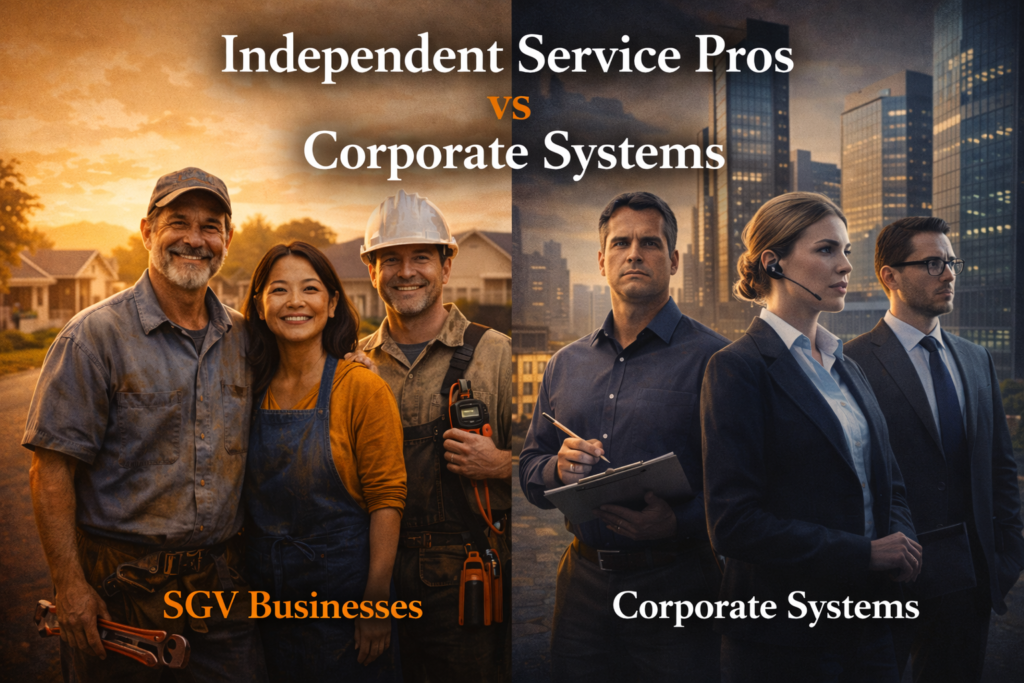
Independent Service Pros vs Corporate Systems | SGV Local Business Advantage
This image illustrates the contrast between independent service professionals in the San Gabriel Valley and large corporate service systems. Local business owners focus on quality, trust, and community relationships, while corporate systems prioritize scalability and centralized operations.
Supporting independent pros helps keep money circulating within the community, strengthens local economies, and preserves personalized service that corporate models often cannot replicate.
Commentary & Local Business
The American Dream Was Never a Franchise
A recent profile of a $22 million power washing empire is an inspiring story — just not one that most local business owners will ever recognize as their own.
There is a story making the rounds on the internet that has been shared widely by business blogs and entrepreneurship publications. It tells of Aaron Harper, a corporate executive who walked away from a near-million-dollar salary offer to acquire and franchise a 35-year-old Pennsylvania power washing company called Rolling Suds. Within three years, he scaled it to 356 territories across 37 states and $22 million in systemwide revenue. It is, without question, a remarkable achievement. And I mean it sincerely when I say I admire the conviction and execution involved.
But here, on the Pasadena Local Businesses blog, I feel a responsibility to look that story squarely in the face and say what many readers are probably already thinking: This is not how most of us start a business. Not even close.
What the article actually describes
The Entrepreneur.com profile details how Harper used a model he calls “franchise through acquisition” — essentially creating a new franchise entity, raising outside capital, and bringing the original business founders along as minority equity partners. He put in $155,000 of his own money and secured additional investment from six other backers, including a former chair of the International Franchise Association. He spent six to nine months building infrastructure — call centers, supplier relationships, marketing vendors — before awarding a single franchise. His typical franchisee needs between $350,000 and $450,000 just to launch.
This is not the story of a person who had a good idea, worked long hours, and built something with their hands. This is a sophisticated capital-deployment strategy executed by someone who spent years inside one of the most powerful franchise development organizations in the country. Harper was not a newcomer to business — he was a franchise industry insider who leveraged deep institutional knowledge and investor relationships to move fast.
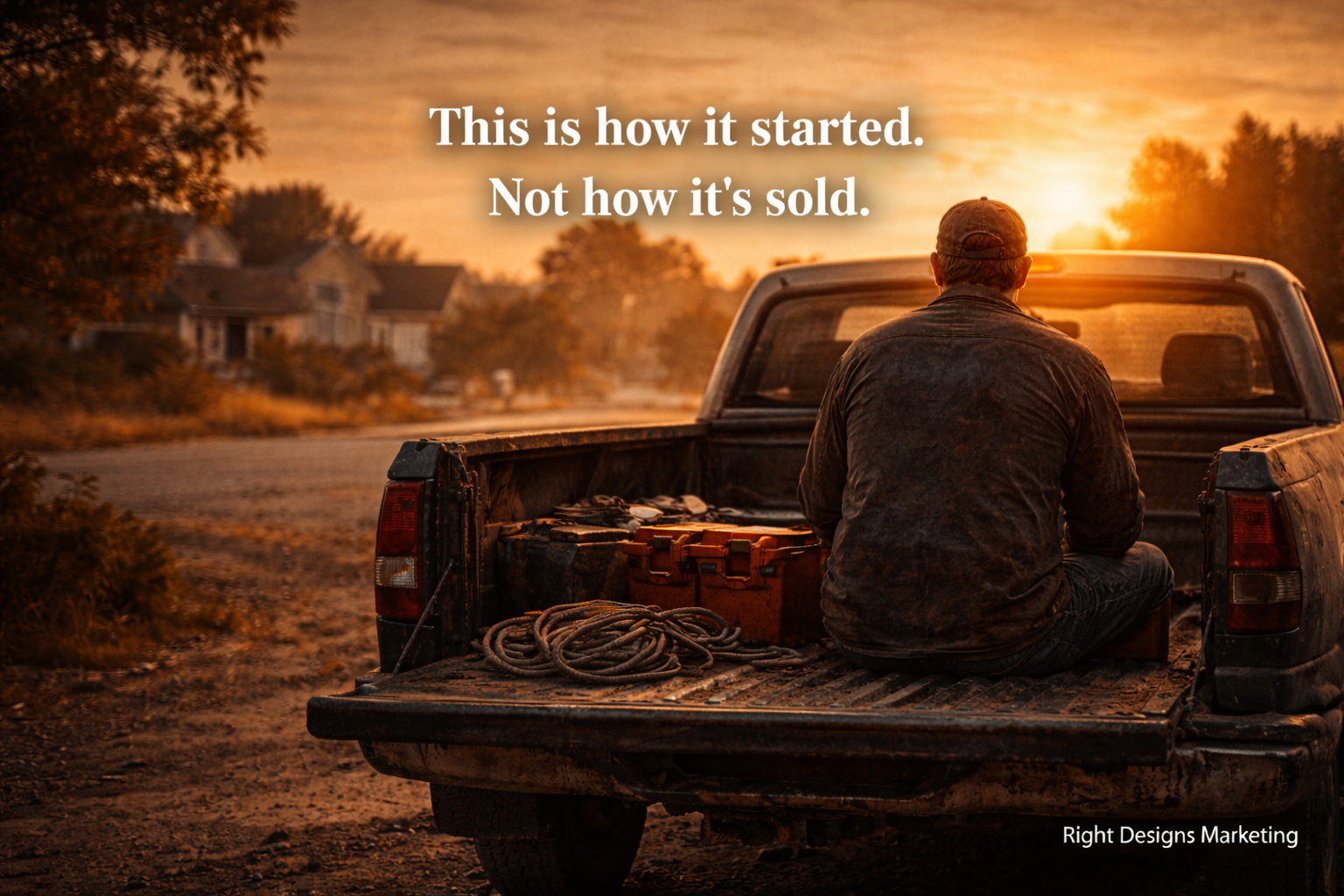
Local independent service pros still fight for visibility while larger corporate systems dominate attention across the San Gabriel Valley.
The real American small business story
The small business that actually built this country looks nothing like a Rolling Suds franchise launch. It looks like a plumber who starts taking weekend jobs while still working for someone else, saving until there’s enough for a used van and a few tools. It looks like a seamstress turning her dining room into a workroom. It looks like a couple opening a taqueria on a shoestring, doing every job themselves for years before they can afford to hire anyone. It looks like a family-owned hardware store that has been passed from parent to child for three generations.
These businesses are started with personal savings, family loans, and credit cards — rarely with outside investors, rarely with a pre-built national support system, and almost never with the kind of capital that a franchise model demands. The U.S. Small Business Administration has long documented that the overwhelming majority of small businesses launch with minimal startup capital. Many begin with less than $10,000. The idea that entrepreneurship in America requires a $400,000 buy-in is not only wrong — it is actively discouraging to the people who most need to believe that starting a business is possible for them.
The franchise model: impressive, but not independence
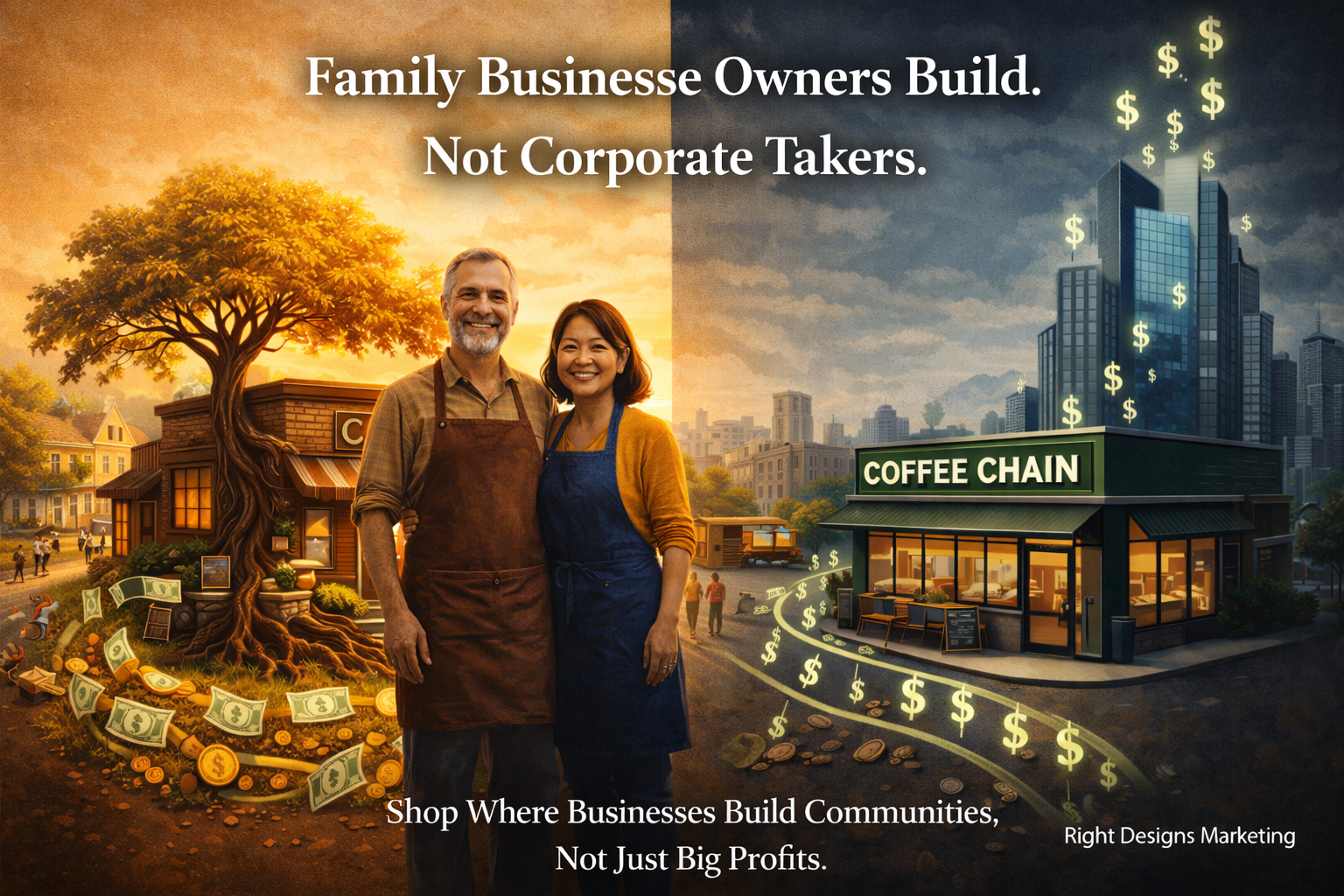
There is another point worth making that often gets lost in the celebratory coverage of franchise success stories. A franchisee is not, in the truest sense, an independent business owner. They operate under a brand they do not own. They follow systems they did not build. They pay ongoing royalties and fees to a corporate franchisor for the privilege of using a name. When Rolling Suds succeeds, a portion of every dollar earned flows upward — out of the local market and back to the entity that owns the brand.
Compare that to the Pasadena bakery whose owner designed her own recipes, built her own customer base, and whose profits stay entirely in this community. Or the independent landscaper who has been serving the same neighborhoods for 20 years, building real relationships — not contractual service territories. That money circulates here. It pays local suppliers, local employees, local rent. That is what we mean when we talk about the backbone of local economies.
What local business owners can take from this story
- Know your market deeply before you scale. Harper spent months studying 23 different industries before choosing power washing. You may not have his resources, but researching your own neighborhood’s needs costs nothing.
- Build systems before you grow. He created infrastructure — operations, customer service, lead generation — before acquiring his first outside customer. Document your own processes early, even when you’re a one-person shop.
- Recurring revenue is the goal. Rolling Suds prioritized commercial contracts that renewed automatically. Any local business that can convert one-time customers into regulars — through memberships, retainers, or service agreements — becomes more stable.
- Know when to hand off. Harper hired a CEO when he recognized his strengths were in building, not operating at scale. Knowing your own limitations is not a weakness — it is wisdom.
- Bring your community in as stakeholders. The original Rolling Suds founders became equity partners rather than being bought out and left behind. That principle — of building alongside people rather than over them — is something any local owner can apply.
Inspiration should tell the whole truth
None of this is to diminish what Aaron Harper built. He identified an opportunity that no one else had, assembled the right people, and executed with remarkable discipline. But the framing of stories like his — published on platforms that also sell franchise directories and investment guides — tends to obscure how rare the conditions for that success actually were. He had industry expertise, investor connections, and enough capital to absorb a lengthy pre-launch build period. Most people starting a business in Pasadena today have none of those things.
What they have is determination, community knowledge, and a skill that someone needs. That has always been enough to build something real. The American business tradition is full of people who started with less than $10,000 and created enterprises that lasted decades and passed to their children. That story does not make the cover of Entrepreneur magazine. But it is still the story that matters most in communities like ours.
So read Harper’s story and find what you can use in it. There is wisdom in there about preparation, systems, and knowing your market. But do not read it and believe for a moment that you need a million-dollar network and a $400,000 buy-in to belong to the tradition of American entrepreneurship.
You already do.
Get Listed in Pasadena
Join other local businesses building visibility and trust in the Pasadena community.
Get Listed